How to Choose a Jump Cue: What Actually Makes a Good Jump Cue

Jumping a ball in pool looks dramatic, but it is a finesse shot. The best jump cue is the one that lets you lift the cue ball cleanly over an obstacle and land it where you want — not the one that hits the ball the hardest.
Here is what actually makes a jump cue good, and how to choose one.
What Makes a Ball Jump
To jump the cue ball, you have to drive the cue stick downward into the cue ball at an angle. That downward force compresses the cue ball into the cloth, and the cloth rebounds the ball up off the table. The ball becomes airborne, clears the obstacle ball, and lands on the other side.
This means a jump cue has to do two things at once: deliver a sharp, clean downward strike, and do it without digging the tip into the cloth. That requires the right combination of weight, stiffness, tip, and length.
Why Cue Weight Matters
A jump cue should be light. A lighter cue lets you accelerate quickly into a short, controlled stroke. A heavy cue is harder to flick downward accurately and tends to push through the ball rather than pop it up.
Most dedicated jump cues (and the jump segment of a jump-break cue) are noticeably lighter than a playing cue. That lightness is the whole point — it gives you the quickness to strike down and recover.
Shaft Stiffness
A jump shaft needs to be stiff. If the shaft flexes too much on the downward strike, energy is lost and the hit becomes unpredictable. Carbon fiber is ideal here because it is both stiff and light — exactly the combination a jump shot demands.
For more on why carbon behaves this way, read our carbon fiber shaft guide.
Tip Construction
The tip on a jump cue is usually hard — often phenolic or a very hard leather. A hard tip transfers the sharp downward strike cleanly and does not absorb the energy the way a soft playing tip would.
The trade-off is forgiveness. A hard tip miscues more easily if your stroke is off, so technique matters. But for a clean jump, a hard tip is the right tool.
Cue Length
Jump cues are shorter than playing cues. A shorter cue is easier to control on the short, downward stroke a jump requires, and it lets you get over the ball at the right angle without the butt getting in the way.
Some jump cues are full-length dedicated jumpers; others are the short rear section of a three-piece cue.
Short vs Long Jumps
Different jumps call for different technique:
- Short jumps (close obstacle) need a steeper angle and a soft touch. Pop the ball just enough to clear.
- Long jumps (obstacle further away) need a shallower angle and more pace, so the ball travels in the air and lands further out.
A good jump cue handles both. The skill is in matching your stroke angle and pace to the distance.
Three-Piece Jump Cue Advantages
A three-piece jump cue (sometimes called a jump-break cue) can be configured for different shots:
- Full length — use it as a break cue.
- Shortened — remove a section to use it as a dedicated jump cue.
That versatility is why many players carry a three-piece. You get one tool that covers two of the most specialized shots in pool, which saves space in your case and money in your wallet.
The trade-off is that a combo is rarely quite as optimized as a dedicated jump cue or a dedicated break cue. Dedicated tools always edge out hybrids on feel. But a well-engineered three-piece gets very close, and the convenience is real.
Control and Accuracy
The mark of a good jump cue is not how high it can pop the ball — it is how predictably it lands the cue ball. A jump that clears the obstacle but sends the cue ball careening off the table is useless. You want a cue that pops the ball just enough, on the line you aimed.
That control comes from the same things: light weight for a quick stroke, stiffness for a clean hit, and a hard tip for energy transfer.
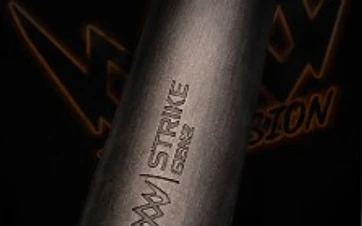
The Precision Air Strike Jump Cue
Our Precision Air Strike Jump Cue is engineered around exactly these principles — lightweight, controllable, and versatile as a three-piece design.
Precision Air Strike Jump Cue (Sports Grip)
A three-piece carbon fiber jump cue engineered to be lightweight, controllable, and versatile.
The philosophy is simple: a jump cue should pop the ball cleanly and land it where you aimed, shot after shot. We kept it light, stiff, and built it to be configured for the shot in front of you.
How to Jump a Pool Ball (Quick Technique Notes)
- Aim slightly downward into the cue ball, not flat.
- Keep your grip hand loose and your stroke short and quick.
- Strike the cue ball above center (toward the top) to drive it down into the cloth.
- Follow through downward — do not stab and stop.
- Match your angle to the obstacle distance: steeper for close, shallower for far.
Practice at short distance first. Clean, low jumps are harder and more useful than high, dramatic ones.
Frequently Asked Questions
Is a jump cue legal in my league? Most leagues allow jump shots with a dedicated jump cue, but rules vary — especially around phenolic tips. Check your league rules before a tournament.
Do I need a separate jump cue? If you jump regularly, a dedicated jump cue (or a good three-piece) makes a real difference. A playing cue is too long and too soft-tipped to jump cleanly.
Carbon fiber or wood for a jump cue? Carbon fiber is the better choice for jump cues because it is light and stiff — the two things a jump shot needs most.
For the other end of the power game, see our guide to the best break cue, or zoom out with our complete pool cue buying guide.